Solar
Three solar routes. One decision: how should your power behave?
Compare the role of the grid, batteries and backup before choosing a solar system. The right answer is driven by outages, essential loads and your available roof.
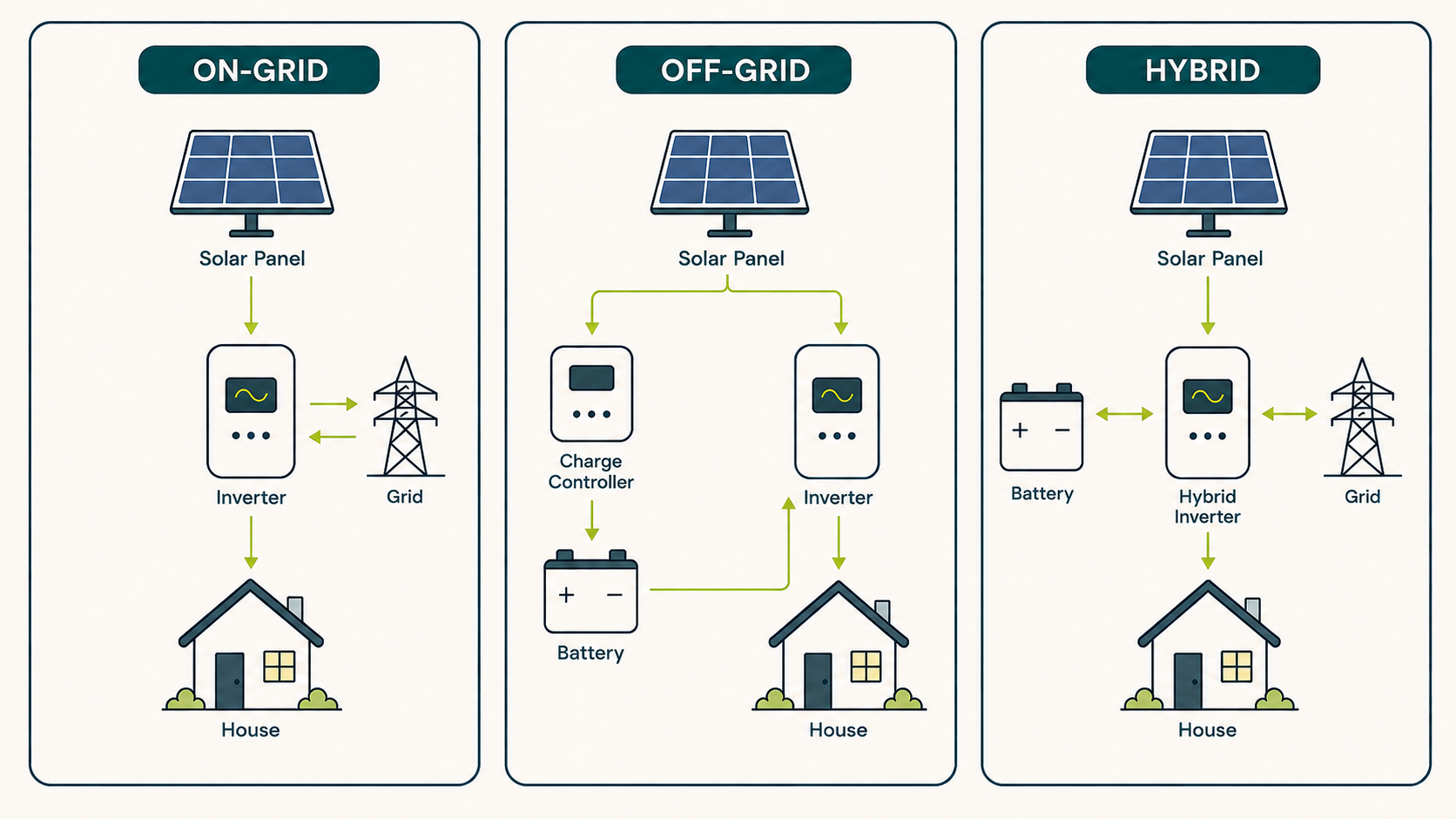
01
On-grid
Connects to the utility grid and reduces daytime electricity use. It switches off during a grid outage for safety.
02
Off-grid
Stores solar energy in batteries and can operate without a grid connection, suited to sites with unreliable or unavailable supply.
03
Hybrid
Combines solar, grid supply and batteries to reduce regular consumption while supporting essential loads during an outage.
Start with your outage requirement.
If lower bills are the priority, on-grid may be right. If power continuity matters, compare hybrid and off-grid systems around the loads you need to keep running.
Solar planning data
What size rooftop solar system do I need for my home in Delhi NCR?
Most homes need about 1 kW of solar capacity for every 1200 to 1400 yearly electricity units, plus roughly 50-60 sq ft of shadow-free roof per kW. The table below gives planning ranges before a site survey and bill review.
| System size | Yearly generation | Recommended roof area | Typical annual savings |
|---|---|---|---|
| 3 kW | 3600-4200 units per year | 150 sq ft | Rs. 21,500-Rs. 25,000 |
| 5 kW | 6000-7000 units per year | 250 sq ft | Rs. 36,000-Rs. 42,000 |
| 10 kW | 12000-14000 units per year | 500 sq ft | Rs. 72,500-Rs. 84,000 |
Generation and savings vary with shade, orientation, season, system design, electricity tariff, net-metering terms and actual consumption. Final capacity and pricing require a site survey and electricity-bill review.